
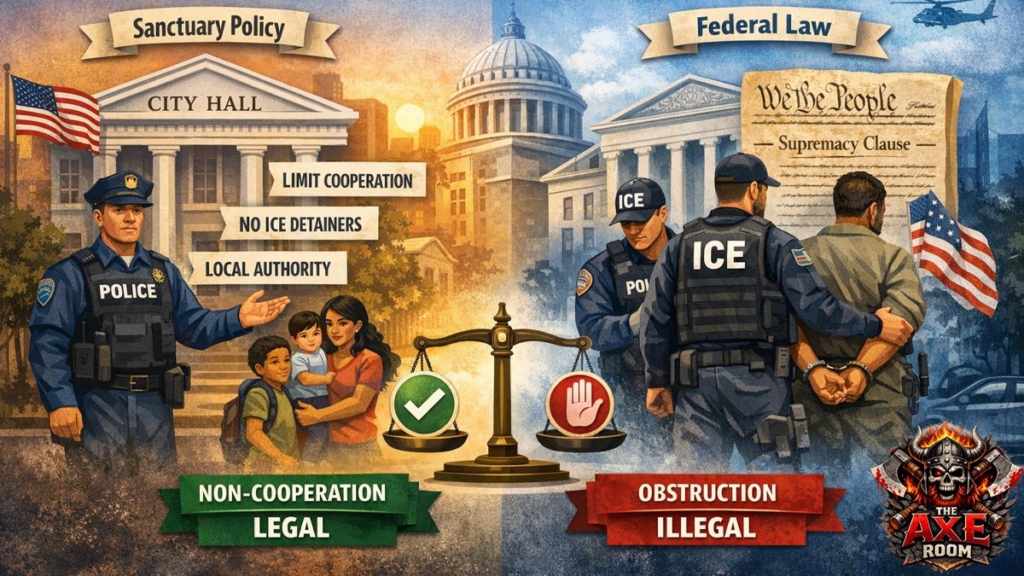
Sanctuary Cities and Federal Immigration Enforcement: What the Law Actually Says
Sanctuary cities are legal under U.S. law, but they operate within firm constitutional and statutory limits. While local governments may choose not to assist federal immigration enforcement, they cannot block or interfere with it. The distinction between non-cooperation and obstruction is the key legal line.
Why sanctuary cities are legal
Under the 10th Amendment and Supreme Court precedent, the federal government cannot force states or cities to use their personnel or resources to enforce federal law. This principle—known as the anti-commandeering doctrine—was affirmed in Printz v. United States (1997) and Murphy v. NCAA (2018). As a result, cities may lawfully decline to honor ICE detainer requests, avoid asking about immigration status, or limit how local police cooperate with immigration authorities.
Why sanctuary cities cannot block ICE
Immigration enforcement is an exclusive federal power, protected by the Supremacy Clause of the U.S. Constitution (Article VI). This means state and local governments may not override, obstruct, or interfere with federal immigration law.
Several federal statutes reinforce this limit:
• 8 U.S.C. § 1324 makes it illegal to conceal, harbor, or shield undocumented immigrants from detection.
• 8 U.S.C. § 1373 prohibits states and cities from restricting officials from sharing immigration status information with federal authorities.
• 18 U.S.C. §§ 111 and 1501 criminalize obstructing or interfering with federal officers performing their duties.
The Supreme Court’s decision in Arizona v. United States (2012) confirmed that states and localities cannot pursue policies that undermine or interfere with federal immigration enforcement, even if they disagree with federal policy.
The legal line
Sanctuary policies are lawful only so long as they do not cross into obstruction. Cities may refuse to help ICE, but they must still allow federal agents to operate freely, execute warrants, and carry out arrests.
Bottom line
Sanctuary cities do not legalize illegal immigration and do not stop deportations. They are legal because local governments cannot be compelled to enforce federal law—but the moment a city hides individuals, blocks arrests, or interferes with federal officers, it violates federal law! In clsoing I feel that sanctuary cities need to go away because they weaken the rule of law by allowing local governments to ignore federal immigration enforcement. This lack of cooperation can protect repeat offenders, strain public resources, and put communities at risk. Immigration laws should be enforced consistently nationwide, not selectively based on local politics. Ending sanctuary policies is about accountability and public safety, not targeting law-abiding immigrants.