
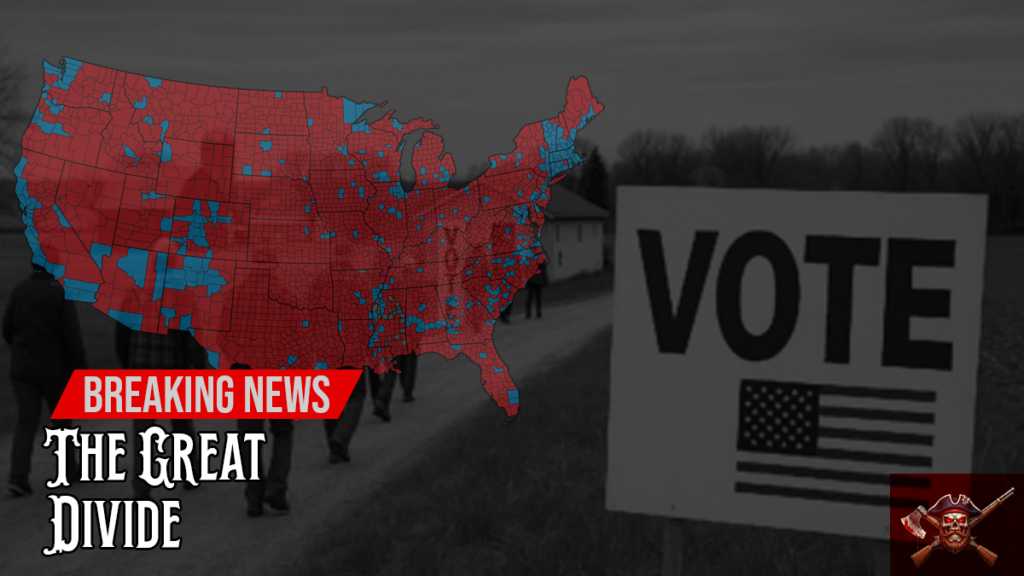
The American electoral map is a study in optical illusion. After any national election, a glance at the county-by-county results reveals a sea of crimson stretching from the Atlantic to the Pacific, punctuated only by isolated islands of blue. In the most recent election cycles, this trend has solidified into a startling statistic: Republicans consistently carry approximately 86% of the nation’s 3,143 counties, while Democrats hold a mere 14%.
To a casual observer, the map suggests a lopsided mandate. To political strategists, however, it represents the “Great Divergence”—a deepening chasm between the sprawling, low-density rural heartland and the hyper-dense, economically powerhouse urban centers. For the Democratic Party, this geographic concentration is not just an electoral hurdle; it is increasingly viewed as a structural threat to the future of their governance and the stability of American democracy itself.
The Geometry of Power: Land vs. People
The discrepancy between county counts and population counts is the fundamental engine of American political friction. While Republicans control the vast majority of the “land,” Democrats represent the vast majority of the “people.”
According to recent data from the Brookings Institution, the 2,633 counties won by the GOP in 2024 account for roughly 86% of the U.S. landmass but only about 38% of the national GDP. 1 Conversely, the sliver of counties won by Democrats—centered in places like Los Angeles, Chicago, and New York—generates over 60% of the nation’s economic output.
This geographic sorting has created two distinct Americas:
- The Red Counties: Characterized by agricultural, manufacturing, or extractive economies. They value local autonomy, traditional social structures, and are often skeptical of centralized federal overreach.
- The Blue Counties: Characterized by “knowledge economy” hubs—tech, finance, and higher education. These areas are racially diverse, socially progressive, and dependent on complex infrastructure and international trade.
Why the 86/14 Split Matters
The 86% figure is more than a trivia point; it dictates how power is distributed in a federalist system. The U.S. Constitution was designed to balance the interests of “the people” (represented in the House) with the interests of “the states” (represented in the Senate and the Electoral College).
Because Democrats are packed into a small number of high-density counties, their votes are essentially “wasted” in the pursuit of geographic-based power. A Democrat in Manhattan might win their county by 80 points, but that landslide provides no more electoral leverage than a Republican winning a rural Wyoming county by 10 points.
1. The Senate Stranglehold
The Senate is the primary arena where the 86/14 split becomes a governing wall. Since every state receives two senators regardless of population, the GOP’s dominance in rural, low-population states gives them a structural advantage. Democrats argue that this allows a “minority” of the population (living in those 86% of counties) to block legislation supported by the majority.
2. The Judicial Pipeline
Control of the Senate leads directly to control of the federal judiciary. By winning the vast majority of rural counties and the states they occupy, Republicans have been able to confirm a generation of conservative judges. Democrats view this as a “geographic bypass” of the popular will, where the courts can strike down policies—like climate regulations or reproductive rights—that are overwhelmingly supported by the urban majorities.
The Democratic Perspective: A “Direct Threat” to Democracy
Mainstream Democratic rhetoric has shifted from viewing the rural-urban divide as a “challenge” to labeling it a “threat.” This urgency stems from several key fears:
The Crisis of Legitimacy
Democrats frequently point out that they have won the popular vote in seven of the last nine presidential elections, yet the geographic distribution of GOP voters allows Republicans to hold the White House and the Senate frequently. When a party that represents only 14% of the counties (but over 50% of the people) is consistently locked out of power, it creates a crisis of legitimacy. Democrats argue that this “minority rule” erodes faith in the democratic process, leading to the radicalization of the base on both sides.
The “Project 2025” and Structural Realignment
Many Democrats see the GOP’s focus on the “86%” as a deliberate strategy to dismantle the modern administrative state. Because the red counties generally favor deregulation and smaller government, a GOP trifecta (White House, House, and Senate) can use its geographic mandate to defund the very urban institutions—public transit, arts, and social safety nets—that Democrats rely on.
Gerrymandering and State Control
The 86% county dominance gives Republicans control over the vast majority of state legislatures. This, in turn, allows for “surgical” gerrymandering. By drawing congressional lines that “pack” Democrats into a few urban districts and “crack” the rest across rural areas, the GOP can secure a legislative majority even if they lose the statewide popular vote. Democrats view this as a “locked room” scenario where they can no longer win back power through traditional means.
The Economic Polarization
The divide is also increasingly fiscal. As the Brookings study noted, the economic “engines” of the country are blue, while the “infrastructure” is red.
- Democratic Fear: They worry that a rural-dominated government will prioritize “dying” industries (coal, traditional manufacturing) over the “future” industries (AI, green energy, biotech) that sustain the national GDP.
- Democratic Reality: They feel they are “subsidizing” the red counties. Most federal tax revenue is generated in high-output blue counties, which is then redistributed to rural counties in the form of agricultural subsidies, infrastructure grants, and social programs.
“We are witnessing a decoupling of economic power and political power,” says one Democratic strategist. “The people who create the wealth are no longer the people who write the laws. That is a recipe for revolution or collapse.”
Can the Divide Be Bridged?
For Democrats to survive this geographic bottleneck, they have two options, neither of which is easy:
- The “50 State Strategy”: Democrats must figure out how to win back at least some of the “86%.” This would require moving to the center on cultural issues—guns, religion, and energy—to appeal to rural voters who feel the party has become a “coastal elite” club.
- Structural Reform: Some in the party advocate for the abolition of the Electoral College, the expansion of the Supreme Court, or the granting of statehood to D.C. and Puerto Rico. However, because the GOP controls the very levers (the Senate) required to pass these changes, such reforms remain a distant dream.
Summary of the Divide
| Feature | Democratic Counties (14%) | Republican Counties (86%) |
| Population Density | High / Urban | Low / Rural |
| Economic Base | Tech, Finance, Services | Agriculture, Mfg, Energy |
| Share of GDP | ~62% | ~38% |
| Political Strength | Popular Vote, House | Senate, Electoral College |
| Primary Value | Diversity & Progress | Tradition & Autonomy |
Conclusion
The “86% to 16%” split is the defining geometry of 21st-century American politics. While the red map looks invincible, it is a shell over a country where the majority of citizens live in the blue dots. For Democrats, the threat is existential: if they cannot find a way to translate their population numbers into geographic power, they face a future where they are a permanent “urban opposition” in a country governed by a rural minority.
Conversely, for Republicans, the 86% is a badge of honor—a sign that they represent the “real America” that sits outside the skyscraper shadows. As long as this divide persists, the United States will remain a nation of two peoples, divided by a common map.